
Why so many learning interventions still don’t stick.
Currently, I have two weeks off. I love spending time in nature, and I love reading and keeping up to date with what’s going on in my fields of work. During the long walks with my dog, I’ve had a lot of time to reflect about learning, about change, and about why so many learning interventions still don’t stick.
Because here’s the thing: Even in 2025, we’re still fighting an old enemy — too much flash, too little function.
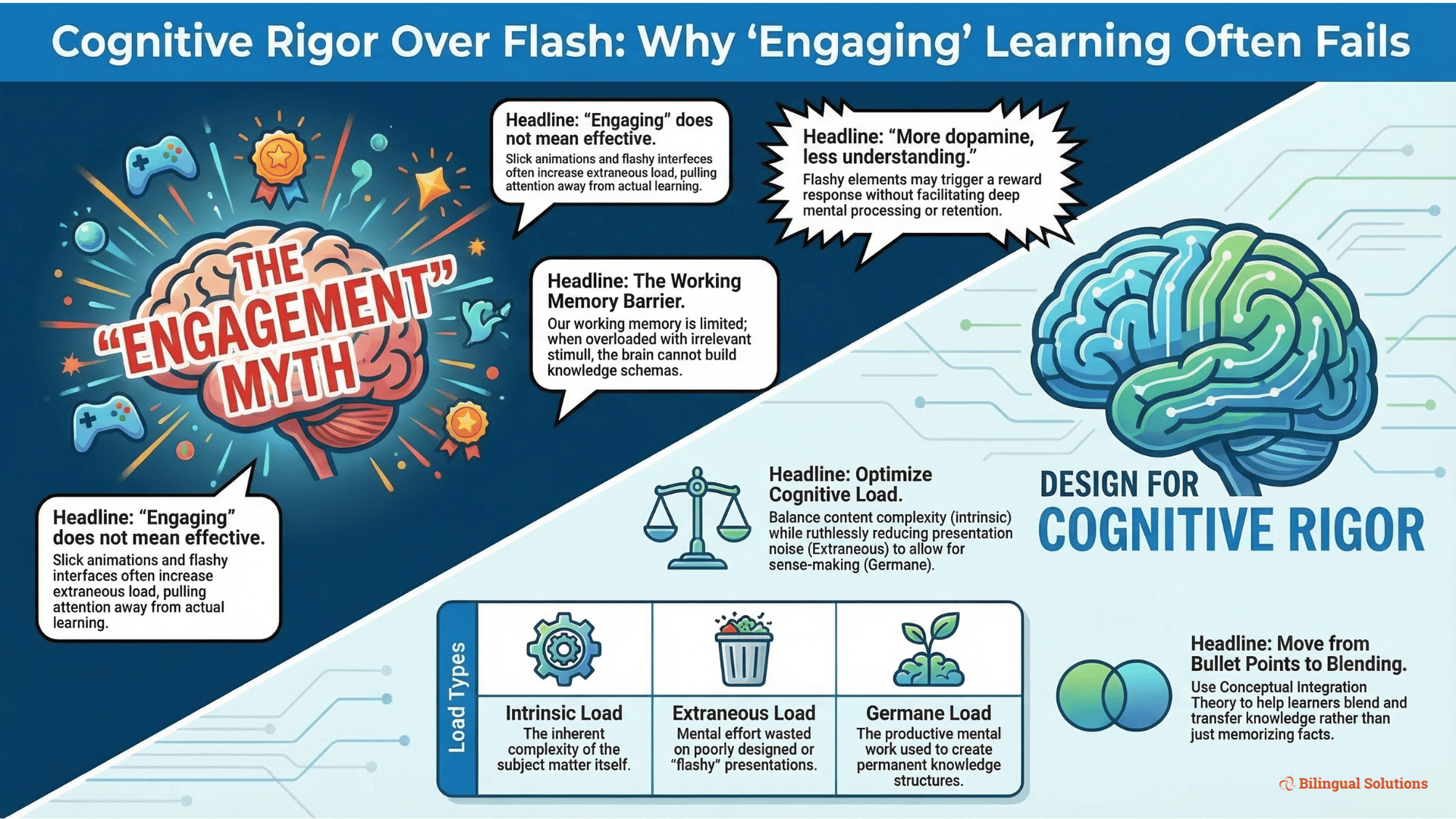
🧠 The Myth of “Engaging = Effective”
We all know those digital learning experiences: slick animations, click-through elements, bright colors, gamified progress bars.
They look engaging. But do they help learners build real understanding?
Cognitive Load Theory, developed by John Sweller, says: Not necessarily. In fact, often the opposite. Sweller explains that our working memory can only hold a limited amount of information at once. When it’s overloaded, we can’t build schemas — the mental structures that let us store and retrieve knowledge efficiently. He identifies three types of cognitive load:
• Intrinsic Load: how complex the content itself is
• Extraneous Load: how hard the presentation makes it to learn
• Germane Load: the mental work involved in making sense of it all
🎆 Flashy interfaces often increase extraneous load by pulling attention toward irrelevant stimuli. The result? More dopamine, less understanding.
🎓 Why This Matters to Me: From Cognitive Linguistics to Learning Design
My approach is shaped by my academic roots. I come from cognitive linguistics and cognitive musicology two fields that ask big questions about how we process language, structure, non-verbal input, and of course recursion. Much of my (still unfinished) PhD work at the University of Cologne focused on how humans build meaning in non-verbal cognitieve Domains and how the brain processes what we perceive. So for me, it’s not just what we present to the brain that matters. It’s how the brain is making sense of it, because meaning is constructed — always.
👉 Event-Related Potentials like the N400 (linked to semantic incongruity) and P600 (linked to syntactic errors or integration difficulty) show just how sensitive our brains are to structure, flow, and cognitive expectations. (Yes, challenge me on that — I’m always up for a good debate.)
🔬 Doing It Right and Making It Work
Having done a large part of a PhD in a traditional academic setting means something else too: Rigor. Critical thinking. The constant battle for proof.
I want to do it right, while making it work in real life. That’s why I question every testing method, assessment tool, learning trend or methodology that crosses my path:
👉 What does the research say?
👉 What school of thought underpins this?
👉 Does it hold up when applied to real people with real cognitive limitations?
Because when eLearning gets too flashy, when the concepts behind it get too shallow, and when providers claim “anyone can build great eLearning”… that’s where the problems begin.
Instructional design is a profession. And it’s one that takes a deep understanding of:
• How learning works
• How cognition works
• And how humans create, blend, and transfer knowledge over time
(📚 Yes, if you haven’t read Steven Pinker’s work on language and mind, now’s a good time. 😉)
📚 Theories I Use Daily — Because They Work
These aren’t just academic talking points. They’re my daily tools:
🔹 Cognitive Load Theory (Sweller) — to balance complexity, reduce noise, and make space for learning
🔹 4C/ID — to structure complex skills in a way that builds real-world competence
🔹 Intentional Change Theory (Boyatzis) — because lasting learning needs emotional relevance
🔹 Recursive Triple Loop Learning (Brislin & Bhawuk) — to support long-term transformation
🔹 Conceptual Integration Theory (Fauconnier & Turner) — because deep learning happens through blending, not bullet points
🧭 What It All Comes Down To
Learning that sticks and sparks change isn’t about checking boxes or collecting badges.
It’s about designing for:
✅ Cognitive capacity
✅ Curiosity
✅ Relevance
✅ Emotional resonance
✅ And reflective integration
Anything else is just noise.
🧩 One Last Thought: Why I’m Still a Student
My PhD work is still unfinished — and deliberately so. There’s a central question I haven’t answered yet. And I won’t, until I’ve finished my degree in psychology.
Because I believe we owe it to the people we design for — learners, teams, organizations — to not just have opinions, but understanding grounded in real knowledge. Until I get there, I’ll keep learning, questioning, and building better learning experiences.
💬 What about you?
Which learning theories or insights have changed how you design learning? What do you challenge — or defend — when you see “off-the-shelf” content?
Let’s talk. Critical minds welcome.
Recent Comments